


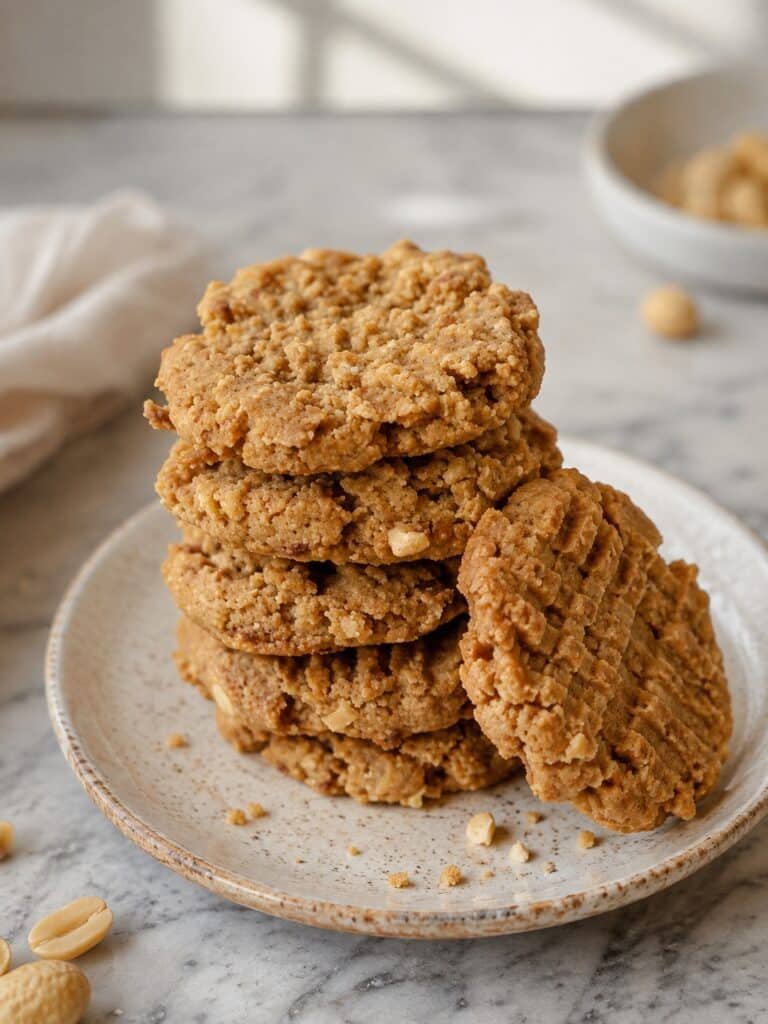

Seven ingredients, no flour beyond a teaspoon and a half of coconut flour, and seventeen minutes. Sixteen cookies at 109 calories each.
Peanut butter is the flour here
A full cup, and it is doing the structural work that wheat flour would in a conventional cookie.
Natural peanut butter specifically, meaning peanuts and salt with no added sugar or hydrogenated oil. The sweetened kind would add carbohydrate the recipe is built to avoid, and its added oils change how the dough sets.
Natural peanut butter separates in the jar. Stir it thoroughly before measuring, or you get a cup that is mostly oil or mostly solids, and neither behaves.
Xanthan gum is doing the binding

A quarter teaspoon, which sounds negligible and is not.
There is no gluten in this dough at all. Xanthan gum is a thickener that mimics some of what gluten does, holding the cookie together so it does not crumble when you lift it.
A quarter teaspoon is the right amount. More gives a slightly gummy texture, which is the common failure with xanthan gum in baking.
Distribute it evenly rather than dropping it in one spot, where it clumps into a gel.
A teaspoon and a half of coconut flour, and no more
Coconut flour absorbs several times its own weight in liquid, far more than wheat flour does.
That is why the quantity is so small. Adding a tablespoon instead of a teaspoon and a half would give you a dry, crumbly dough that will not hold together.
It is not interchangeable with almond flour, which absorbs far less. If you substitute almond flour, you would need roughly three times as much.
Reserve a teaspoon of sweetener
A third of a cup goes into the dough and a teaspoon is held back for the tops.
The recipe mentions this reservation several times because it is easy to tip the whole lot in. Sprinkled on before baking, that teaspoon gives a slight sparkle and a bit of crunch that the cookie otherwise lacks.
Granulated rather than powdered for the topping. Powdered dissolves into the surface and disappears.
Do not overmix
Stirred until combined and no further.
The recipe’s own tips flag this and it applies even without gluten. Overworking a peanut butter dough breaks down the emulsion and produces a tougher, denser cookie.
Stop as soon as everything looks uniform.
Chill sticky dough
Ten to fifteen minutes in the fridge if it is difficult to handle.
Natural peanut butter and coconut oil are both softer at warm room temperature, and the dough can be too loose to scoop. Chilling firms both.
Do not chill it for long. Cold coconut oil makes the dough hard and it cracks when you press the fork in.
Wet the fork
Dipped in water or oil before pressing the criss-cross.
Peanut butter dough grips a dry fork and lifts off the tray with it. A dipped fork releases cleanly.
Re-dip every few cookies rather than once at the start.
Seven to nine minutes, watched
The cook time field says seven and the instructions say seven to nine.
Use the range and check early. These are done at very light brown around the edges, and the tips suggest checking a minute or two before the minimum, which is sound advice for a cookie this small and this quick.
They will be soft coming out. Cool them on the sheet for a few minutes before moving.

About the nutrition
The source notes that the sugar-free sweetener is not included in its figures, since most people subtract it to reach net carbs.
That is disclosed rather than hidden, and it is standard practice in low carb recipes. Worth knowing if you are comparing these figures against a recipe that counts sweetener differently. <p>Three grams of carbohydrate and one gram of fibre per cookie as stated. ## Sweetener choices The source uses a granulated monk fruit and allulose blend. Any granulated sugar-free sweetener that measures like sugar works in its place.
Erythritol blends give a slight cooling sensation some people notice. Allulose does not and browns more like sugar, which suits a cookie.
Avoid powdered versions here, since the reserved teaspoon on top is meant to stay visible.
Room temperature egg
Which the tips recommend. A cold egg into a cup of peanut butter firms the mixture and makes it harder to blend smooth. Twenty minutes on the counter is enough.
Keto Peanut Butter Cookies
Description
Easy keto peanut butter cookies made with natural peanut butter, coconut flour and a sugar-free sweetener.
Ingredients:
Instructions
-
Preheat the oven to 375F (190C).
-
In a mixing bowl combine the natural peanut butter, egg and the 1/3 cup of granulated sweetener, holding back the reserved teaspoon. Blend until smooth. Stir the peanut butter thoroughly in the jar before measuring, since it separates.
-
Add the coconut oil and mix well. Warm it gently first if it has gone hard.
-
Incorporate the coconut flour and xanthan gum, distributing them evenly rather than dropping them in one spot.
-
Pour in the vanilla and mix until just combined, stopping there as overmixing gives a tougher cookie.
-
Using a cookie scoop or spoon, place small portions onto a parchment lined cookie sheet, leaving space between each. If the dough is sticky, chill it 10 to 15 minutes first.
-
Use a fork dipped in water or oil to gently press a criss-cross into each cookie, flattening them slightly. Re-dip every few cookies.
-
Sprinkle the reserved teaspoon of granulated sweetener over the tops.
-
Bake 7 to 9 minutes, checking from 7, until very light brown around the edges. They will be soft coming out.
-
Cool on the sheet a few minutes before transferring to a wire rack to cool completely..
Note
Use natural peanut butter, meaning peanuts and salt with no added sugar or hydrogenated oil, and stir it thoroughly before measuring since it separates in the jar. The quarter teaspoon of xanthan gum is doing the binding in place of gluten; distribute it evenly rather than dropping it in one spot, and do not increase it or the texture goes gummy. Coconut flour absorbs several times its weight in liquid, which is why only a teaspoon and a half is used; it is not interchangeable with almond flour. Reserve a teaspoon of granulated sweetener for the tops. Chill sticky dough 10 to 15 minutes but no longer, as cold coconut oil makes it crack. Dip the fork in water or oil before pressing. The cook time field says 7 minutes and the instructions say 7 to 9; use the range and check early. The source excludes the sugar-free sweetener from its nutrition figures, which it discloses.