


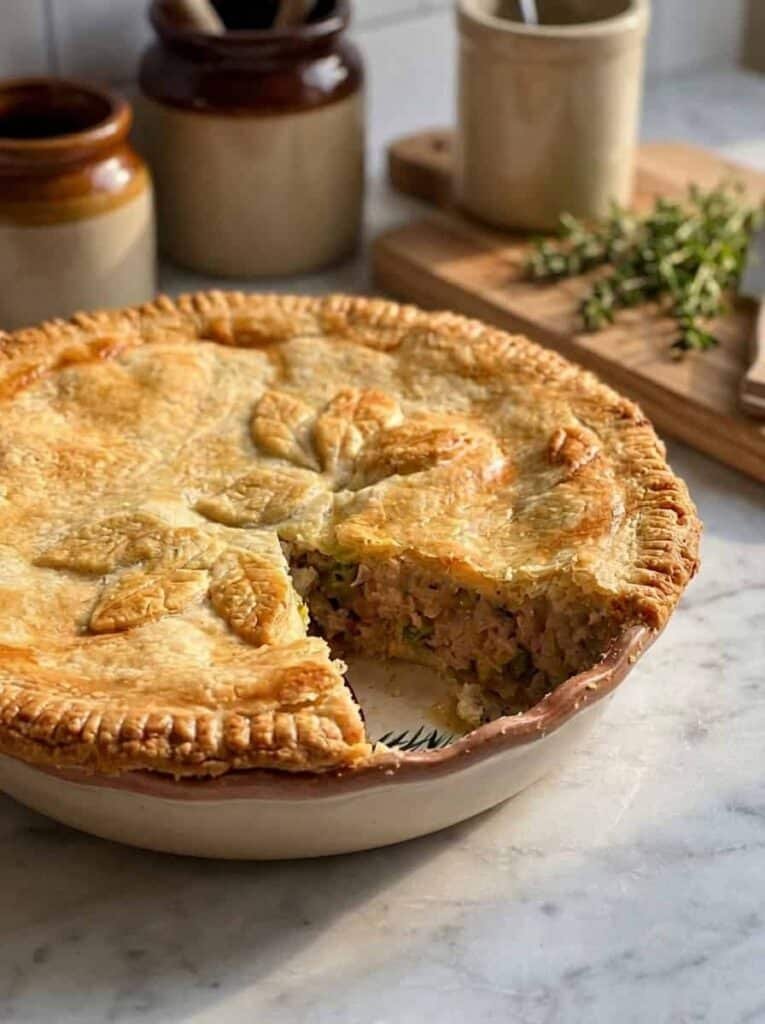

Leftover pork, store-bought pie crusts, and a gravy built in one saucepan. That is a whole pot pie with about ten minutes of actual work in front of it.
This exists to use up what is left of a roast, and it does that job better than sandwiches do. Three cups of cooked pork, shredded or cubed, disappears into a thyme and Dijon gravy under a golden double crust.
The roux comes first
Four tablespoons of butter melted in a three quart saucepan, then four tablespoons of flour cooked in for two to three minutes.
Equal parts butter and flour, which is the standard ratio for a gravy roux. Those two or three minutes of cooking are what remove the raw pasty taste of flour. Skip them and the finished gravy will taste faintly of uncooked dough underneath everything else.
Then switch from a spoon to a whisk before the liquid goes in. A whisk breaks up lumps as they form. A spoon pushes them around.
Whisk continually as it thickens

Chicken stock, salt, pepper, minced garlic and Dijon mustard all go in, and you whisk without stopping for four to five minutes until the mixture heats and thickens.
Continually is the word that matters. Roux-thickened gravy forms lumps the instant liquid meets flour that has not been dispersed, and once they set they will not whisk out. Adding the stock gradually while whisking is more forgiving than pouring it in all at once.
The Dijon is not just seasoning. Mustard is an emulsifier and it helps keep the gravy smooth and glossy rather than separating as it sits in the pie.
Then the filling goes in
Thyme, pork and thawed frozen mixed vegetables stirred through with a wooden spoon, and cooked until heated through.
Thawed rather than frozen matters. Frozen vegetables dropped into hot gravy release water as they thaw, which thins the gravy right back out after you spent five minutes thickening it. Thaw them and pat them dry.
Everything here is already cooked, so this stage is only about heating and combining. A few minutes is plenty.
Roll the crust onto the rolling pin
The transfer is where pie crusts tear, and this is the trick.
Roll the pastry loosely around the rolling pin, lift it, position it over the pie pan and unroll it back down. The pin supports the whole sheet so nothing stretches or splits under its own weight.
Press it into the pan and let the excess hang over the sides. Do not trim yet.
Seal it properly
Second crust on top, transferred the same way, then trim the excess with a paring knife and press the edges together with a fork.
Fork tines do two things at once. They physically crimp the top and bottom crusts into each other, and they leave the ridged pattern that makes a pie look finished. Press firmly all the way around, because a seal that opens in the oven lets the gravy boil out.
Cut steam holes
Several slashes in the top crust with a paring knife.
A sealed pie full of hot wet filling turns into a pressure vessel. Steam has to go somewhere, and without holes it will find the weakest point of your seal and blow it open. The holes also let moisture escape so the top crust crisps rather than steaming soft from underneath.
Egg wash for colour
One egg whisked with a tablespoon of water, brushed over the top.
Egg alone browns very fast and can go patchy. Thinned with water it spreads into an even layer and gives a uniform golden shine. This is purely cosmetic and it makes a large visual difference.
If you cut leaf shapes from the trimmings, stick them down with a little water before the egg wash goes on.
Bake on a sheet
375F, forty to forty five minutes, until the crust is golden and the filling is heated through.
The baking sheet underneath is worth using. Pot pies bubble over more often than not, and gravy on the oven floor burns and smokes for weeks afterwards.
Cool twenty minutes
This is not optional if you want clean slices.
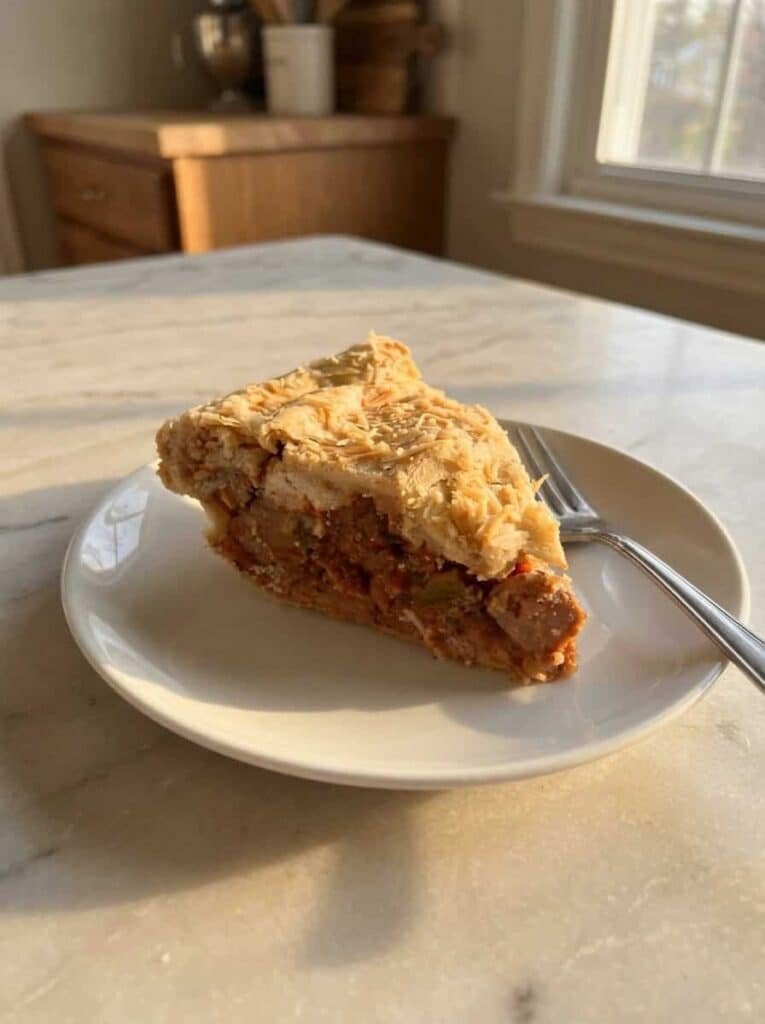
Straight from the oven the gravy is liquid and a cut slice collapses into a puddle. Twenty minutes lets it set enough to hold. Eight servings, around 463 calories each, and it keeps five days refrigerated.
Freezing it
Freeze after baking, either whole or in individual portions, for up to two months. Thaw overnight in the refrigerator and reheat uncovered at 350F until hot through. Reheating uncovered is what keeps the crust from going soggy.
Using other leftovers
Chicken, turkey and beef all work in place of pork with no other changes. Beef is better with the Dijon swapped for a teaspoon of Worcestershire, and turkey suits sage more than thyme.
Homestyle Pork Pot Pie
Description
A comforting pot pie using leftover roast pork, frozen vegetables and a quick Dijon gravy in a double pie crust.
Ingredients:
Instructions
-
Preheat the oven to 375F (190C).
-
On a lightly floured surface roll out one pie crust. Roll it loosely onto the rolling pin and unroll it over a pie pan sprayed with non-stick spray. Press it in and let the excess hang over the sides.
-
Melt the butter in a 3 quart saucepan over medium heat. Add the flour and cook 2 to 3 minutes, stirring occasionally. Switch to a whisk and add the chicken stock salt pepper garlic and Dijon mustard. Whisk continually until the mixture heats and thickens, about 4 to 5 minutes.
-
Using a wooden spoon stir in the thyme pork and thawed vegetables. Cook, stirring occasionally, until heated through.
-
Pour the filling into the prepared crust. Roll out the second crust, transfer it over the filling on the rolling pin and unroll to cover.
-
Trim the excess dough with a paring knife, saving some for optional leaf shapes, and press the edges together with a fork to seal.
-
Cut steam holes into the top crust. Adhere any cut-out leaf shapes with a little water.
-
Whisk the egg with the water and brush over the top crust.
-
Place the pie on a baking sheet and bake 40 to 45 minutes, until the crust is golden brown and the filling is heated through.
-
Cool at least 20 minutes before slicing and serving..
Note
Nutrition per serving from source: 463 calories, 34g carbohydrates, 20g protein, 27g fat, 11g saturated fat, 86mg cholesterol, 710mg sodium, 379mg potassium, 3g fiber, 1g sugar. Thaw and pat dry the frozen vegetables, or they will thin the gravy. Cook the roux 2 to 3 minutes before adding liquid, and whisk continually as it thickens. Cut steam holes in the top crust. Bake on a sheet pan to catch any bubbling over. Cool at least 20 minutes before slicing. Keeps 5 days refrigerated or 2 months frozen after baking.