


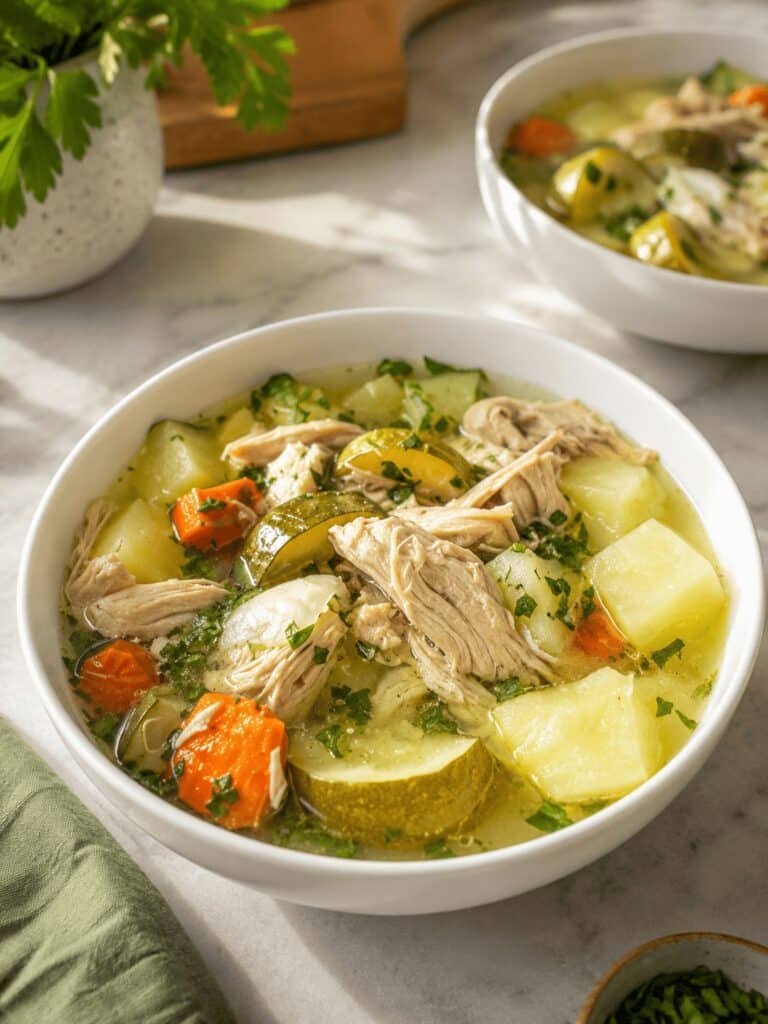

Chicken leg quarters simmered until the meat falls off the bone, then large chunks of carrot, potato, zucchini, chayote and onion cooked in that broth until tender.
Two hours and ten minutes, eight servings, and almost all of the time is unattended simmering. This is Sunday food, made in the biggest pot you own.
Leg quarters, not breast
Five pounds of chicken leg quarters, which means thigh and drumstick still attached.
Bone and skin are the entire point. Two hours of simmering pulls collagen out of the bones and connective tissue, and that is what gives the broth body rather than leaving it thin and watery. Breast meat has neither and would go dry and stringy long before the two hours were up.
The meat should fall off the bones on its own by the end. If it is still clinging after an hour, give it longer. There is no penalty for going past two hours with dark meat.
Cut everything large
Carrots, potatoes, zucchini, chayote and onion all in large chunks.

This is deliberate and it goes against the instinct to dice things evenly. Large pieces survive forty five to sixty minutes of simmering and still hold their shape when you spoon them into a bowl. Small dice would dissolve into the broth and you would end up with cloudy soup and no vegetables.
Chayote is a pale green squash common across Mexico and Central America, mild and slightly crisp, and worth seeking out at a Latin grocer. If you cannot find it, more zucchini works, or a piece of peeled kohlrabi.
About the salt
The recipe calls for two tablespoons of salt plus a chicken bouillon cube, and the finished soup comes out at around 2,080mg of sodium per serving.
That is a high figure and worth knowing before you start. For context, most daily guidelines sit around 2,300mg total.
The reason it climbs so high is the volume of liquid being seasoned. Two gallons of water needs a lot of salt to taste of anything, and the bouillon cube adds more on top. Nothing about that is unusual for a soup of this scale.
If you want it lower, start with one tablespoon of salt, skip the bouillon cube, and season each bowl at the table instead. The source note suggests salting to taste anyway.
Two gallons is a lot of water
Roughly seven and a half litres, before any vegetables go in.
Check your pot before committing. A standard eight quart stockpot will not hold two gallons plus five pounds of chicken plus several pounds of vegetables. You need something closer to a twelve quart pot, or you scale the recipe down.
If your pot is smaller, reduce the water until the chicken is just covered. The soup will be more concentrated, which is not a bad outcome.
Keep the lid on
The source is specific about this and it is worth following: the pot should be covered whenever you are not actively adding something.
Over two hours, an uncovered pot loses a substantial amount of liquid to evaporation. You would end up with a much smaller volume of much saltier soup, since the salt does not evaporate with the water.
The order of operations
Chicken, water, minced garlic, salt and garlic powder go in together and simmer for one to two hours until the meat falls off the bone.
Then the bouillon cube goes in and dissolves, and all the vegetables follow. Forty five to sixty minutes more at medium-low until the carrots and potatoes are tender.
Carrots and potatoes are the slowest of the vegetables, so they set the timing. Zucchini and chayote will be soft well before then and that is accepted in this style of soup rather than a problem to engineer around.
Cilantro at the very end
Half a bunch chopped, stirred in for the final five minutes.
Cilantro is fragile. Boiled for an hour it turns dark and loses everything that makes it worth adding. Five minutes in hot broth is enough to release its flavour while it still tastes fresh.
How to serve it
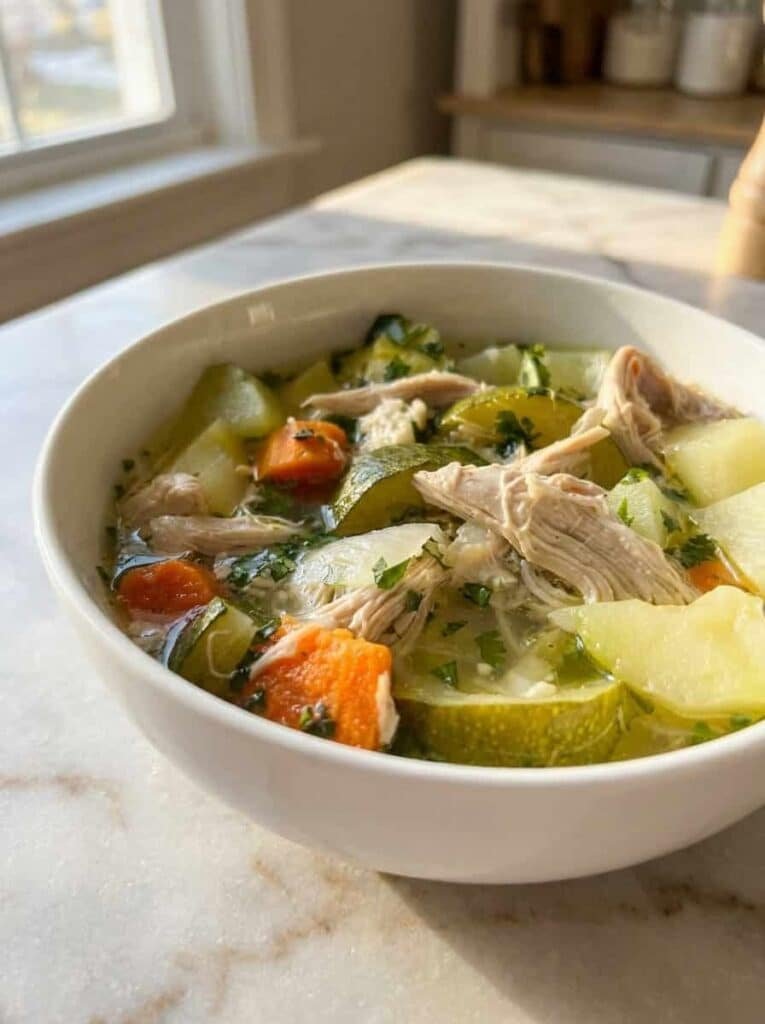
Warm corn tortillas alongside, with Spanish rice and refried beans if you are making a full meal of it.
Lime wedges at the table are worth adding. A squeeze of lime over a bowl of caldo brightens the whole thing and cuts the richness of the broth.
Chicken doneness
Poultry should reach an internal temperature of 165F. After one to two hours at a simmer this is not in question, but the source works entirely on the visual cue of meat falling from the bone, which is a reliable indicator here.
Storing it
Three to four days refrigerated. The potatoes soften further on reheating and the broth thickens slightly as their starch continues to release. Both are normal. It freezes reasonably well, though the potatoes and zucchini lose texture.
Caldo de Pollo
Description
A traditional Mexican chicken and vegetable soup built on leg quarters simmered slowly with large cut vegetables.
Ingredients:
Instructions
-
Place the chicken legs into a large stockpot and cover with the water. Add the minced garlic salt and garlic powder
-
Cover the pot and bring to a boil over high heat. Reduce to a simmer and cook until the chicken meat falls off the bones, 1 to 2 hours. Keep the lid on except when adding ingredients
-
Stir in the chicken bouillon cube until dissolved, then add the carrots potatoes zucchini chayote and white onion
-
Reduce the heat to medium-low and simmer until the carrots and potatoes are tender, 45 to 60 minutes
-
Stir the chopped cilantro into the soup and simmer 5 minutes
-
Serve hot with warm corn tortillas and lime wedges.
Nutrition Facts
Servings 8
- Amount Per Serving
- Calories 606kcal
- % Daily Value *
- Total Fat 25g39%
- Saturated Fat 7g35%
- Cholesterol 160mg54%
- Sodium 2080mg87%
- Potassium 1490mg43%
- Total Carbohydrate 42g15%
- Dietary Fiber 7g29%
- Sugars 6g
- Protein 52g104%
* Percent Daily Values are based on a 2,000 calorie diet. Your daily value may be higher or lower depending on your calorie needs.
Note
Sodium is high at 2080mg per serving, which comes from 2 tablespoons of salt plus a bouillon cube across a large volume of liquid. To reduce it, use 1 tablespoon of salt, omit the bouillon cube and season individual bowls at the table. Two gallons of water requires roughly a 12 quart pot; reduce the water if yours is smaller. Keep the lid on except when adding ingredients. Poultry should reach 165F.