


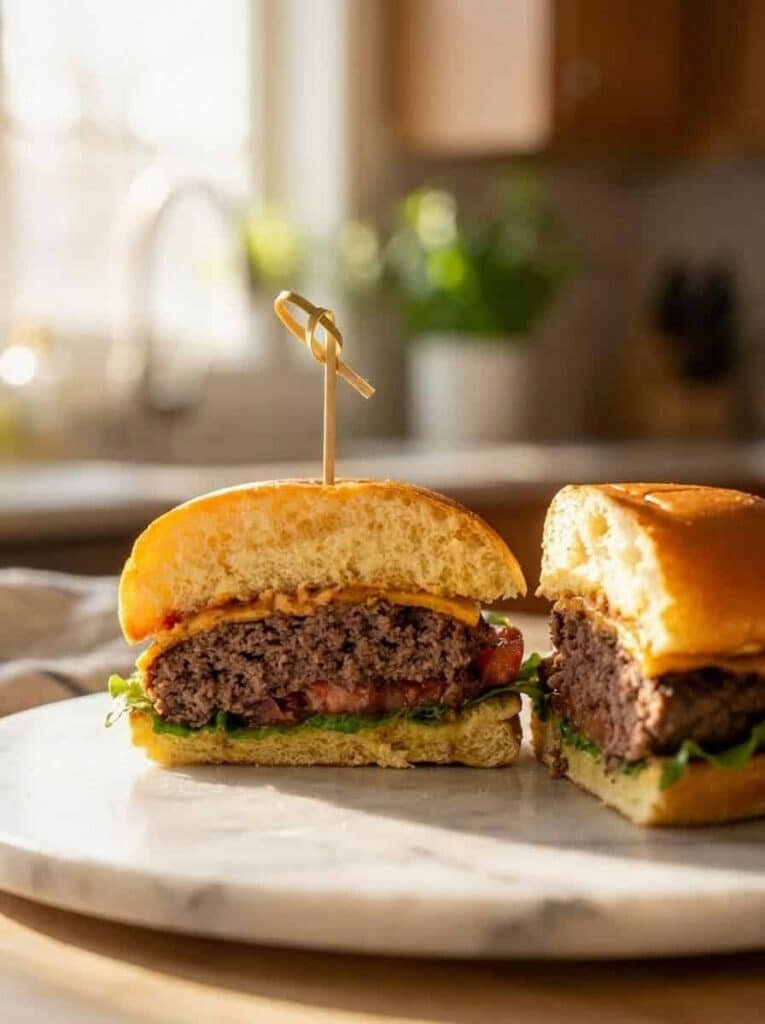

Bison is leaner than beef, which is the whole reason this recipe exists and also the thing that makes it easy to ruin.
Two pounds of ground bison with salt, pepper, Worcestershire and Dijon, cooked in a cast iron skillet for six to eight minutes total.
Dimple the middle of each patty
A shallow indent pressed into the centre with your thumb before it hits the pan.
Burger patties contract as they cook, and they contract more at the edges than the centre, which pushes the middle up into a dome. A domed burger sits badly on a bun and cooks unevenly.
The dimple gives that contraction somewhere to go. As the edges pull in, the centre rises to fill the indent and you end up with a flat patty.
Shallow rather than deep. You are compensating for a bulge, not making a bowl.
Mix gently and stop early
Just until combined, and no further.

Working ground meat develops the proteins into a springy network, the same way kneading develops gluten in dough. That gives you a burger with a bouncy, sausage-like texture rather than a tender crumbly one.
Bison is leaner than beef, so there is less fat cushioning that effect. Overmixed bison goes tough faster than overmixed beef does.
Use your hands and treat it like folding rather than kneading.
Get the skillet properly hot first
Cast iron over medium-high, butter or oil swirled to coat, and give it time to come up.
A hot surface sears immediately and forms a crust. A lukewarm one lets the patty release its juice, which then simmers around it, and lean meat that has released its moisture has nothing left to give back.
Cast iron holds heat, which matters when six cold patties go in. A thinner pan drops in temperature and never recovers.
Three to four minutes a side
Then cheese in the last minute with a cover to melt it.
Ground meat should reach an internal temperature of 160F. The recipe says to cook to desired doneness, which is the standard instruction for a whole-cut steak and not the right one for ground meat.
The distinction matters. On a steak, any bacteria are on the surface and searing kills them. Grinding distributes surface bacteria throughout the meat, so the whole patty needs to reach temperature.
Bison is often served pink because it is lean and dries out quickly, and that is a genuine tension. Six to eight minutes total in a hot pan on a three quarter inch patty gets you to 160F without overshooting badly.
Worcestershire and Dijon in the mix
A teaspoon and a half of each across two pounds.
Both are doing the same job, which is adding moisture and savoury depth to a meat that has less of its own fat to carry flavour.
Worcestershire brings anchovy, tamarind and vinegar. Dijon brings acidity and acts as a mild emulsifier, helping the mixture hold together without turning it rubbery the way an egg binder would.
Neither is detectable as itself in the finished burger.
Toast the buns in the same pan
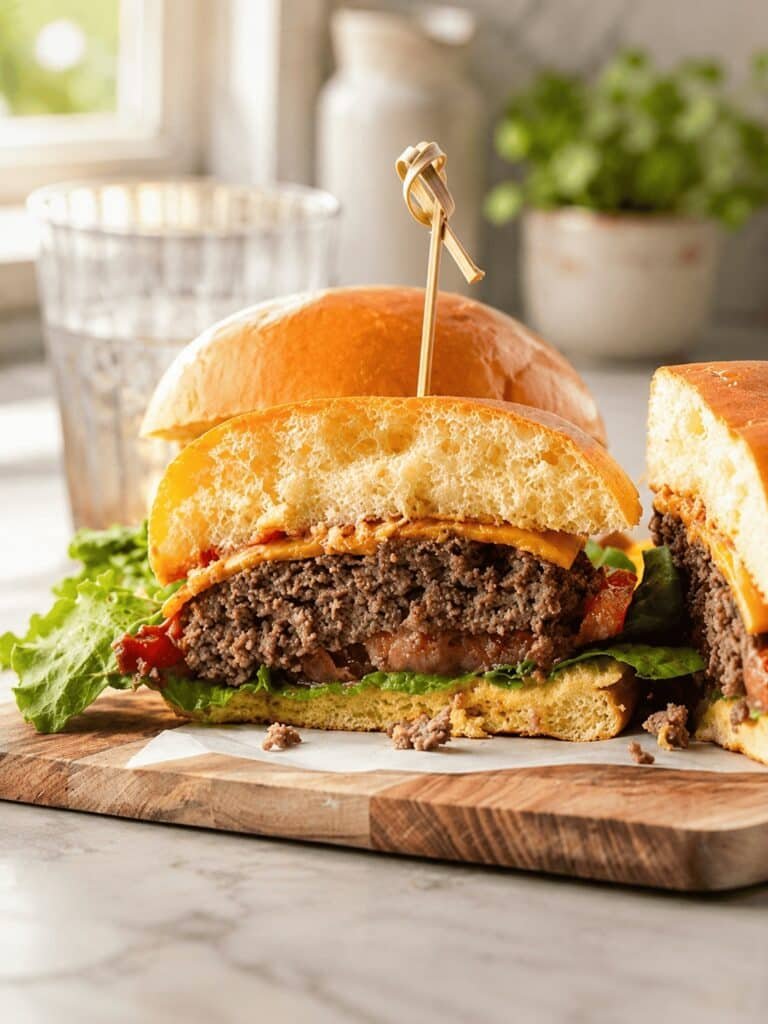
Cut side down, thirty to sixty seconds after the burgers come out.
The pan has rendered fat and browned bits in it, and toasting the buns in that picks up flavour a toaster cannot give you. It also creates a slight barrier that stops the bun going soggy under a juicy patty.
About the quantities
The source lists six servings, six to eight patties, and four to five buns and cheese slices, which do not agree with each other.
Two pounds of meat makes six patties at a sensible size, so six is what appears here. Buy six buns and six cheese slices rather than the four to five listed.
The sodium
Around 1,020mg per serving, which is on the higher side. <p>It comes from a teaspoon and a half of kosher salt in the meat, plus the cheese, the bun and the Worcestershire stacking on top. Reducing the salt in the mix to a teaspoon brings it down without much noticeable difference, since the cheese is already salty. ## Toppings Caramelised onions, pickles, lettuce, tomato, roasted green chiles and aioli are all suggested and all work. Bison is milder and slightly sweeter than beef, so sharp toppings suit it well.
Cheese choice
Cheddar, pepper jack or smoked gouda. Smoked gouda is the interesting one here, since bison has no smokiness of its own and the pan gives it none. Pepper jack adds heat, cheddar is the safe default.
Bison Burgers
Description
Juicy skillet bison burgers with a simple seasoning, melted cheese and buns toasted in the same pan.
Ingredients:
Instructions
-
In a large bowl gently mix the ground bison, salt, pepper, Worcestershire and Dijon just until combined. Do not overwork it.
-
Form into 6 patties about 3/4 inch thick and press a shallow indent into the centre of each one.
-
Heat a cast iron skillet over medium-high heat. Add the butter and swirl to coat the pan, letting it come fully up to temperature.
-
Place the patties in the hot skillet and cook 3 to 4 minutes on the first side. Flip and cook another 3 to 4 minutes, until the internal temperature reaches 160F. Add the cheese during the last minute and cover briefly to melt.
-
Remove the burgers and place the buns cut side down in the skillet. Toast 30 to 60 seconds until golden.
-
Add the toppings, place the burgers on the toasted buns and serve immediately..
Note
The source gives three different quantities: 6 servings, 6 to 8 patties, and 4 to 5 buns and cheese slices. Two pounds of meat makes 6 patties at a sensible size, so buy 6 buns and 6 cheese slices. Ground meat should reach an internal temperature of 160F; the source says to cook to desired doneness, which is the instruction for a whole cut rather than ground meat, where grinding distributes surface bacteria throughout. Press a shallow dimple into each patty so it stays flat. Mix gently and stop early, since bison is leaner than beef and toughens faster. Nutrition per serving from source: 533 calories, 26g carbohydrates, 40g protein, 30g fat, 16g saturated fat, 197mg cholesterol, 1020mg sodium, 522mg potassium. Sodium is high; reducing the salt in the mix to 1 teaspoon lowers it noticeably.