


Seared tenderloin brushed with mustard, wrapped in mushroom duxelles and ham, then in puff pastry and baked. Four servings, an hour and forty five minutes.
Two temperatures, and which to follow
The recipe says to pull at 125 to 130F for medium rare, which is what any restaurant kitchen does with tenderloin.
The USDA figure for whole cuts of beef is 145F with a three minute rest. That is higher, and the difference is real rather than an error in the recipe.
What 145F does is provide a safety margin against surface bacteria. On a whole intact cut of beef, contamination is almost entirely on the outside, and the sear at the start of this recipe reaches temperatures well above that on every surface. That is the reasoning behind cooking tenderloin rare, and it is why the practice is widespread.
For anyone pregnant, elderly, very young or immunocompromised, cook to 145F. The Wellington will be closer to medium and the pastry timing does not change.
For everyone else it is a judgement call, and it is one worth making knowingly rather than by default.
Rest it before slicing
Ten minutes, which the source does not mention.

Cut straight from the oven, the juices run out onto the board and the pastry underneath goes soggy within a minute. Ten minutes lets them redistribute through the meat.
Rest it uncovered on a rack. Tented with foil, steam collects against the pastry and softens the crust you spent an hour building.
Cook the mushrooms until completely dry
Ten to fifteen minutes, until all the released moisture has boiled away.
This is the step that decides whether the Wellington works. Mushrooms are around ninety percent water, and any of it left in the duxelles turns to steam inside the pastry and produces the soggy bottom this dish is notorious for.
Completely dry means the mixture holds its shape and no liquid pools when you push it to one side of the pan.
Then cool it. Warm duxelles against pastry starts melting the butter in it before the oven does.
Pulse, do not chop
Very finely chopped in a food processor.
A duxelles needs to be a paste rather than a mixture of pieces. Fine texture packs tightly around the beef and does not create gaps where juices collect.
Pulse rather than running the processor continuously, which turns them to slurry.
Plastic wrap does the shaping
Ham laid overlapping on the wrap, duxelles spread over it, beef in the middle, then rolled tight and twisted at the ends.
Trying to wrap ham around beef by hand gives a loose, uneven parcel. The wrap lets you compress it into a tight cylinder, and twisting the ends like a cracker tightens it further.
Twenty minutes in the fridge then sets that shape, so it holds when the wrap comes off.
Limit the pastry overlap
Excess trimmed at the ends, and the recipe is specific: pastry more than two layers thick will not cook through.
That is the other classic Wellington failure. A thick seam stays raw and doughy while the rest browns. <p>Trim generously and accept that you are throwing pastry away.
Chill again before baking
Five to ten minutes after the egg wash.
Cold pastry going into a hot oven puffs harder, because the butter layers stay solid long enough to create steam rather than melting out.
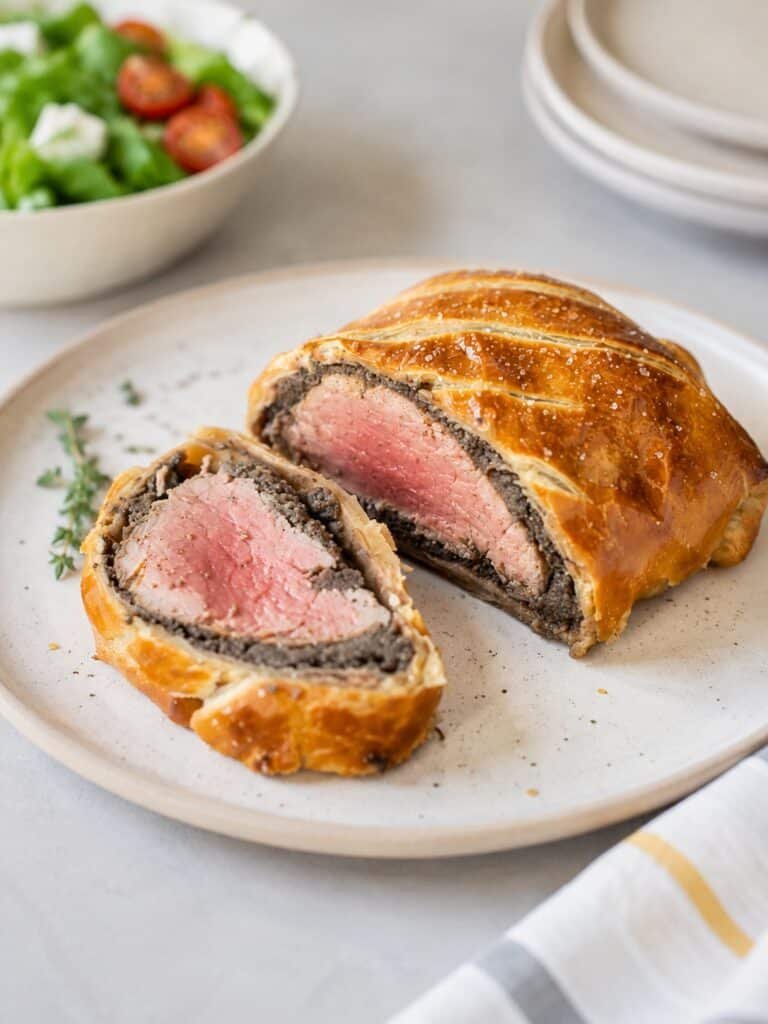
Score the top, not through
With a sharp knife, not going all the way through.
Scoring gives steam somewhere to escape and stops the pastry splitting at a random point. Cutting through defeats it entirely and the juices leak out.
Thawing the pastry
Two to four hours in the refrigerator, or about forty minutes on the counter, until pliable but not soft or squishy.
Over-thawed pastry tears as you roll it and the butter layers have already begun merging, which costs you the puff.
The mustard
Two tablespoons of hot English mustard, brushed on after searing and cooling. Dijon substitutes and is milder.
Brush it on cooled beef rather than hot, since heat drives off the volatile compounds that make mustard sharp.
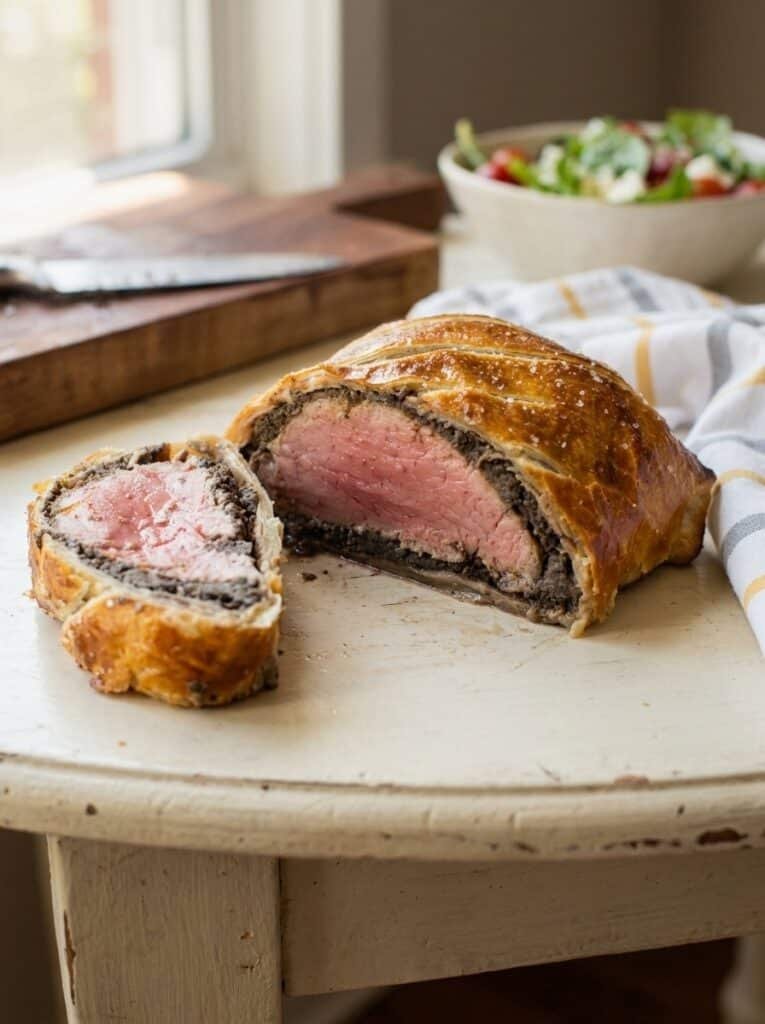

Beef Wellington
Description
A classic beef Wellington with mushroom duxelles and Parma ham in a puff pastry crust.
Ingredients:
Instructions
-
Preheat the oven to 400F as you assemble the Wellington.
-
Season the beef generously with salt and pepper. Heat the oil in a large pan on high and sear the beef on all sides until well browned, about 2 to 3 minutes per side. Do not move it until it has had a chance to brown.
-
Remove the beef and let it cool. Once cooled, brush it on all sides with the mustard.
-
Chop the mushrooms and pulse in a food processor until very finely chopped. Cook in a saute pan over medium-high heat 10 to 15 minutes, until all the released moisture has boiled away and the mixture holds its shape. Set aside to cool completely.
-
Lay the ham slices overlapping on a large piece of plastic wrap, large enough to encase the beef. Spread the cooled mushroom mixture over the ham. Place the beef in the middle and use the wrap to roll it into a tight barrel, twisting the ends to secure. Refrigerate 20 minutes.
-
Roll the puff pastry out on a lightly floured surface to a size that will wrap around the beef. Unwrap the beef and place it in the middle. Brush the pastry edges with beaten egg yolk and fold the pastry around, trimming excess at the ends so no seam is more than two layers thick. Place seam side down and brush all over with egg yolk. Chill 5 to 10 minutes.
-
Place on a baking pan and brush the surface again with egg. Score the top with a sharp knife without cutting all the way through and sprinkle with flaky salt.
-
Bake 25 to 35 minutes until the pastry is nicely golden. Test with an instant read thermometer and pull at 125 to 130F for medium rare, or 145F if cooking to the USDA guideline.
-
Rest 10 minutes uncovered on a rack before slicing..
Note
The source pulls the beef at 125 to 130F for medium rare, which is standard practice for tenderloin. The USDA figure for whole cuts of beef is 145F with a 3 minute rest, and anyone pregnant, elderly, very young or immunocompromised should cook to that instead. The difference is real rather than an error: on an intact cut, contamination is almost entirely on the surface, which the initial sear reaches well above 145F. The source gives no resting step; rest 10 minutes uncovered on a rack before slicing, or the juices run out and the pastry base goes soggy. Cook the mushrooms until completely dry, which is what prevents a soggy bottom, then cool them. Pulse rather than running the processor. Trim the pastry so no seam is more than two layers thick, since thicker will not cook through.