



Minestrone is not a fixed recipe. It is a method: whatever vegetables are in season, simmered with beans and finished with pasta or rice, with Parmesan at the table.
This version runs onion, garlic, celery, carrots, green beans, zucchini, potatoes and red beans. Eight servings, about eighty minutes, and it holds a week in the fridge.
Mash one whole potato
Three potatoes go in, two diced and one left whole. Near the end, you mash that whole one with a fork against the side of the pot.

This is the thickening step and it costs nothing. Potato starch released into the broth turns a thin vegetable soup into something with body, without flour, cream or a blender.
Leaving it whole through the simmer rather than dicing it means it holds together long enough to find and mash. Diced, it would break up on its own and disperse before you could do anything deliberate with it.
Two stages of vegetables
The finely chopped ones first: onion, garlic, celery and one carrot, sautéed five minutes until softened. Then the diced ones and the salt, five minutes more.
The fine chop on the first group is deliberate. Those four are the aromatic base and they need to break down and release their sugars into the oil. Chopped fine they do that in five minutes.
The rest go in as dice because they are meant to stay recognisable in the finished soup. Minestrone should have distinct pieces in it.
Simmer covered, not uncovered
Broth in, brought to a boil, then reduced and simmered covered for forty five to fifty minutes.
Covered keeps the liquid in, which matters over nearly an hour. An uncovered pot loses a good deal to evaporation and you would end up with a much thicker, saltier soup than intended.
A pressure cooker cuts this to fifteen minutes if you have one, which is a substantial saving for the same result.
Beans near the end
Two cups of canned red beans, rinsed and drained, added after the vegetables have softened and cooked five minutes more.
They are already cooked, so all they need is heating through and a little time to take on the broth. Added at the start they would break down into mush over fifty minutes.
Rinse them. The canning liquid is starchy and slightly metallic and there is nothing in a clear vegetable soup to hide it.
Cook the pasta separately, per serving
This is the part of the method that makes minestrone practical to keep, and it is worth following exactly.
When you are ready to serve, add about a quarter cup of water per serving to the pot, bring to a boil, then add about twenty grams of broken spaghettini per serving and cook six to seven minutes covered until al dente.
The extra water is there because the pasta will absorb it. Without it the pasta drinks the broth and you end up with a stew.
Crucially, do not add pasta to any portion you plan to refrigerate or freeze. Pasta sitting in broth overnight goes soft and bloated and keeps absorbing until there is no soup left. Cook it fresh into whatever you are actually serving.
Parmesan at the table
Half a cup grated, sprinkled over each bowl rather than stirred into the pot.
This is how it is served in Italy and there is a practical reason beyond tradition. Cheese stirred into a large pot of soup can split, and it also means anyone avoiding dairy cannot eat it. At the table, everyone takes what they want.
Keeping it
Seven days refrigerated or four months frozen, without pasta.
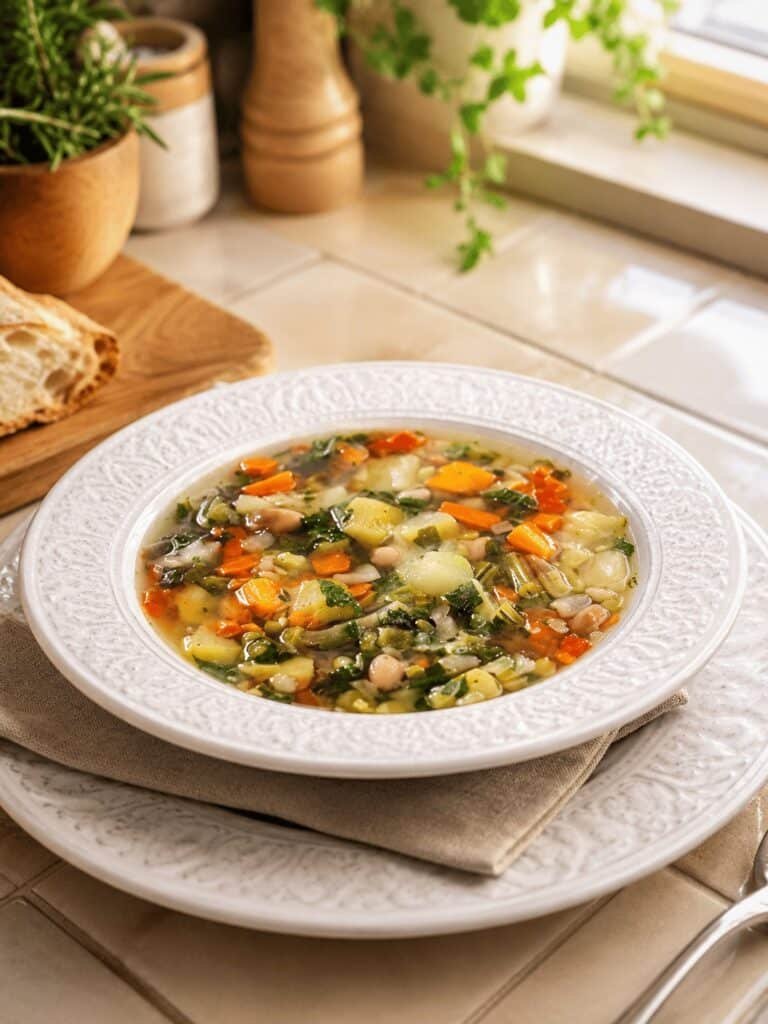
That is a long window for a soup and it is because there is nothing fragile in it. Vegetables and beans in broth hold up well, and the flavour deepens over the first few days. <p>Around 260 calories per serving, and it is naturally halal and free of nuts and peanuts. ## Using what is in season The list here is a starting point rather than a requirement. Minestrone traditionally uses whatever is available, so cabbage, leeks, chard, peas, squash and fennel all belong in it depending on the month.
Keep the ratio roughly the same and add harder vegetables earlier, softer ones later.
Making it vegetarian
Vegetable broth in place of chicken broth is the only change. Check the Parmesan if that matters, since some is made with animal rennet.
Vegetable Minestrone Soup
Description
Classic minestrone with seasonal vegetables, red beans and pasta cooked fresh into each serving.
Ingredients:
Instructions
-
Finely chop the onion garlic celery and one carrot. Dice the other vegetables, keeping one potato whole
-
Heat the oil in a large pot over medium heat. Add the finely chopped vegetables and saute 5 minutes with occasional stirring until softened. Add the remaining vegetables and the salt and cook 5 minutes with frequent stirring
-
Pour in the broth, bring to a boil, then reduce the heat and simmer covered about 45 to 50 minutes, until the vegetables are softened. In a pressure cooker this reduces to 15 minutes
-
Mash the whole potato against the side of the pot using a fork, which will thicken the soup. Add the red beans and cook 5 additional minutes
-
When ready to serve, add about 1/4 cup of water per serving and bring to a boil. Add about 20 g of broken spaghettini per serving, cover and cook over low heat 6 to 7 minutes until al dente
-
Add pepper to taste and ladle into bowls. Sprinkle with grated Parmesan at the table and serve.
Note
Keep one potato whole through the simmer and mash it with a fork near the end; the released starch is what thickens the soup. Chop the aromatic vegetables fine and dice the rest so they stay recognisable. Simmer covered to avoid losing liquid to evaporation. A pressure cooker reduces the simmer from 50 minutes to 15. Rinse the canned beans and add them near the end. Do not add pasta to any portion being refrigerated or frozen; cook it fresh into each serving with about a quarter cup of extra water per portion. Serve the Parmesan at the table rather than stirring it in. Keeps 7 days refrigerated or 4 months frozen without pasta.