


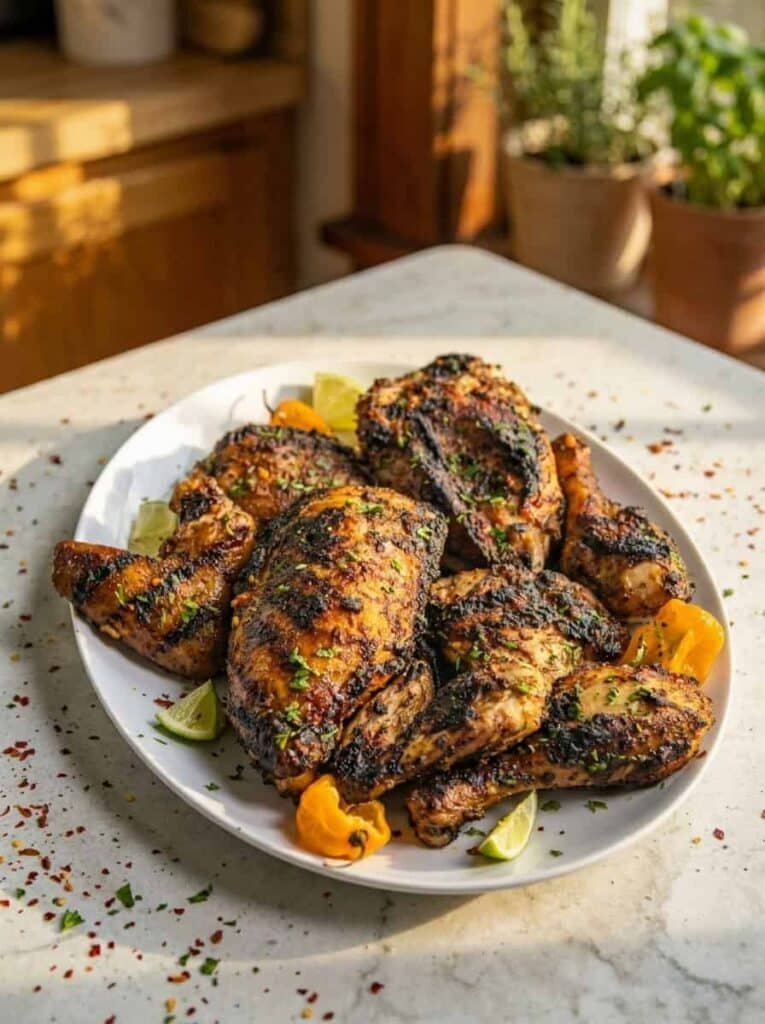

Scotch bonnets, allspice, thyme and ginger blended into a marinade, rubbed into a cut-up chicken and left overnight if you can manage it.
Jerk is a Jamaican cooking method as much as a seasoning, traditionally done over pimento wood. A grill gets you closer than an oven, and an oven works fine.
Handle scotch bonnets with gloves
Four to six of them, chopped, and they are among the hotter chillies you can buy.

Capsaicin is oil soluble and it does not wash off with water alone. It transfers to whatever you touch afterwards, and eyes are the usual casualty an hour later. Disposable gloves, or wash your hands with dish soap and warm water immediately afterwards.
The heat in the finished dish is milder than the pepper count suggests. Blended into a marinade with orange juice, vinegar and brown sugar, then cooked, scotch bonnets land as a warm background rather than sharp heat. Use more if you want it hotter.
Scotch bonnets also carry a distinct fruity sweetness that habaneros only partly share and that no other chilli substitutes well.
Poke holes in the chicken first
Before the marinade goes anywhere near it, poke the chicken all over with a knife.
Marinades penetrate skin and muscle very slowly. Most of what a marinade does happens on the surface. Holes give it channels to travel down, so the seasoning reaches the meat rather than sitting on the outside.
This matters more here than usual because the marinade is thick and there is a lot of it.
Two hours minimum, overnight better
The recipe says at least two hours and that overnight gives more flavour penetration, which is accurate.
Two hours seasons the surface and a little below. Overnight gets the allspice, thyme and chilli properly into the meat, and the acid from the orange and lime has time to tenderise.
Longer than twenty four hours is not better. The acid starts breaking the surface down into something mealy.
The marinade that touched raw chicken gets thrown away
This is worth being clear about because the recipe mentions two different things in two different places.
Marinade that has been in contact with raw chicken is discarded. It carries whatever the chicken carried and it does not go on cooked meat.
If you want a finishing sauce, reserve some of the blended marinade before it touches the chicken. Then bring that reserved portion to a boil and simmer it five minutes before serving, which cooks the raw onion and garlic in it and thickens it slightly.
Set aside what you want for sauce first, then marinate. Doing it the other way round is not recoverable.
Allspice, nutmeg and cinnamon together
A teaspoon each of allspice, nutmeg and cinnamon, plus dried thyme.
Allspice is the signature. It is the dried berry of the pimento tree, native to Jamaica, and it tastes like a combination of clove, cinnamon and nutmeg in one berry. Jerk without it is not jerk.
The nutmeg and cinnamon alongside it reinforce that same warm profile rather than adding new directions. Together they are what makes jerk taste distinctly Caribbean rather than simply spicy.
Grilling or baking
On a grill: medium-high, oiled grates, twelve to twenty minutes until the chicken reaches 165F internally.
In the oven: 400F for thirty five to forty minutes, again to 165F.
Grilling is traditional and the char adds something an oven cannot. Baking is easier and produces a very good result. Either way the temperature is the thing to check rather than the clock, since cut-up chicken has pieces of different thicknesses.
Dark meat can go to 175F for a more tender texture. Breast should come off at 165F.
Serving
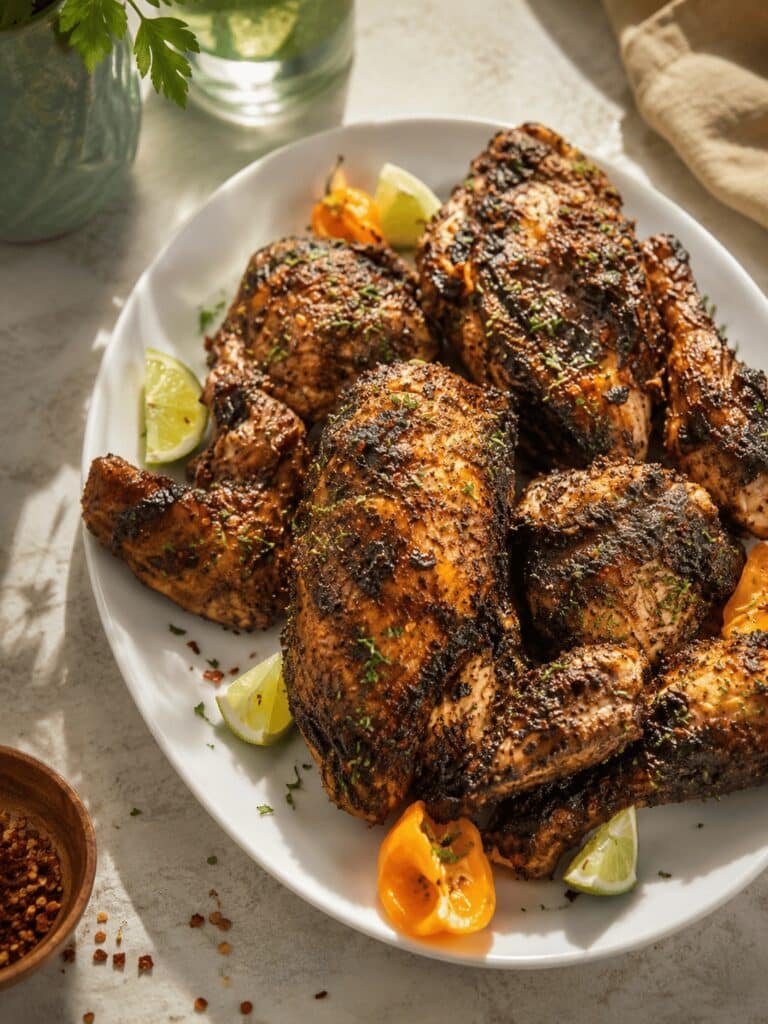
Rice and peas is the traditional partner, along with fried plantain or a simple cabbage slaw. <p>Around 358 calories per serving across six, with 25 grams of protein. ## Adjusting the heat Four scotch bonnets gives a mild to medium result once cooked. Six pushes it to properly hot. Removing the seeds and membranes takes a good deal of the heat out while keeping the fruity flavour, which is a useful middle route.
Which cuts
A whole cut-up chicken is what the recipe calls for and it gives you a mix. Legs and thighs are the better jerk cuts, since the fat and connective tissue stand up to high heat and long marinating better than breast does.
Jamaican Jerk Chicken
Description
Traditional Jamaican jerk chicken with a spicy scotch bonnet marinade, suitable for the grill or the oven.
Ingredients:
Instructions
-
Add all the marinade ingredients to a food processor or blender and process until smooth. Wear gloves when handling the scotch bonnets.
-
If you want a finishing sauce, set some marinade aside now before it touches the chicken.
-
Poke holes in the chicken with a knife so the marinade can penetrate more deeply.
-
Set the chicken into a large bowl or sealable bag. Pour the marinade over and rub it in until completely covered.
-
Cover and refrigerate at least 2 hours, or overnight for more flavour. Discard the marinade that touched the raw chicken.
-
To grill: heat a charcoal or gas grill to medium-high and lightly oil the grates. Grill 12 to 20 minutes, until the chicken reaches 165F internally.
-
To bake: heat the oven to 400F and bake 35 to 40 minutes, until the chicken reaches 165F internally.
-
If serving the reserved marinade as a sauce, bring it to a boil then simmer 5 minutes before serving alongside..
Note
The source lists the cuisine as American; this is Jamaican. Wear gloves when handling scotch bonnets, since capsaicin is oil soluble and does not wash off with water alone. Poke holes in the chicken before marinating so the marinade penetrates. Marinate at least 2 hours and preferably overnight, but not beyond 24 hours. Marinade that has touched raw chicken must be discarded. If you want a finishing sauce, reserve some before marinating, then boil it and simmer 5 minutes before serving. Chicken should reach an internal temperature of 165F; dark meat can go to 175F for texture. Nutrition per serving from source: 358 calories, 9g carbohydrates, 25g protein, 24g fat, 6g saturated fat, 95mg cholesterol, 476mg sodium, 374mg potassium, 1g fiber, 5g sugar.