Creamy Corn Miso Pasta
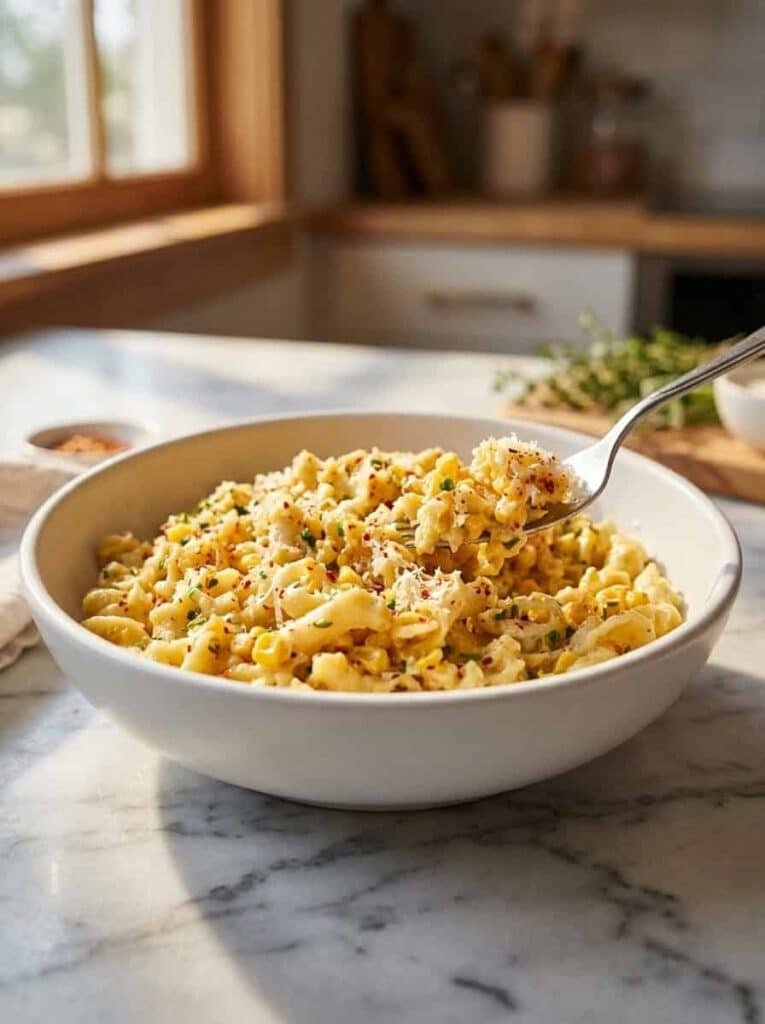
Corn blitzed into a sauce, loosened with miso and pasta water, and tossed through campanelli. There is no cream in it and it comes out silky anyway.
Four servings, fifty minutes, and it is a summer dish that depends entirely on the corn being good.
Scrape the cobs after cutting
This is the step that separates this from a dish with corn in it.
After you cut the kernels off, run the back of a knife or a spoon down each stripped cob over the bowl. What comes out is a starchy white liquid, sometimes called corn milk, along with the bases of the kernels still attached to the cob.
That liquid is where a good deal of the corn flavour lives, and its starch is part of what thickens the finished sauce. Skip it and you throw away both.
Two ears gives about a cup and a half of kernels plus whatever you scrape.
Cook the corn until the pan looks dry
Three minutes with the onion and garlic until it starts to soften and the mixture appears dry, then half a cup of water added and cooked three to four minutes more until most of it evaporates.
That drying stage is deliberate. You are concentrating the corn rather than boiling it, and the water added afterwards steams it tender without diluting what you just built.
Waiting for most of the water to evaporate again matters for the same reason. A wet corn mixture blends into a thin sauce.
Hold back half a cup before blending
Half the cooked corn mixture goes into a small bowl and stays whole.
A quarter cup of that gets pulsed back into the food processor twice at the end, which gives the sauce texture rather than leaving it completely smooth. The remaining quarter cup goes on top at serving as whole kernels.
Without that, you have a uniformly smooth sauce and no corn to bite, which loses the point of using fresh corn at all.
Do not wipe the skillet
The corn mixture goes into the food processor and the skillet stays as it is.
Everything stuck to the pan is caramelised corn sugar and softened onion, and the processed sauce goes straight back into it. Wiping it out means starting the sauce in a clean pan and leaving that flavour behind.
Miso in, off the boil
Two tablespoons of white miso whisked into the warmed corn mixture with half a cup of pasta water.
White miso is the mildest of the misos, fermented for a shorter time, and it is sweet and lightly salty rather than assertive. Against corn, which is also sweet, it adds a savoury depth that makes the dish taste like more than vegetables.
Whisk it in rather than dropping it in as a lump. Miso paste does not disperse on its own and you would find salty pockets.
Reserve a full cup of pasta water
Half goes in with the miso. The rest goes in a tablespoon at a time at the very end.
Pasta water is starchy, and that starch is the emulsifier holding this sauce together in the absence of cream. Adding the second half gradually lets you stop at exactly the consistency you want, which changes depending on how much water your corn released.
Salt the pasta water generously. It is seasoning the pasta and it is going into the sauce.
Parmesan and lemon off the heat
Pan off the burner, then the Parmigiano-Reggiano, then the remaining pasta water, then the lemon juice.
Cheese stirred into a simmering pan splits into oil and strings. Off the heat it melts into the sauce smoothly.
The tablespoon of lemon juice at the end is doing more work than its quantity suggests. Corn, miso and Parmesan are all rich and savoury with no acidity between them, and without the lemon the whole bowl sits heavy.
Gochugaru rather than chilli flakes
Half a teaspoon of Korean chilli flakes.
Gochugaru is coarser and fruitier than Italian chilli flakes and considerably less sharp. It brings colour and a mild warmth rather than heat, which suits a sweet corn sauce. Ordinary chilli flakes work at half the quantity, though they read hotter and less rounded.
Serve immediately

Chives, the reserved corn and extra Parmesan on top. <p>Three days refrigerated. Reheat gently with a splash of water, since the sauce tightens considerably as it cools. ## Frozen corn It works out of season and the dish is noticeably less good, mostly because there is no cob to scrape and no corn milk. Add a tablespoon of the pasta water extra to compensate for the missing starch. Fresh corn in season is the reason to make this.
The pasta shape
Campanelli is ruffled and hollow, which traps a loose sauce well. Orecchiette, shells and fusilli all do the same job. Long pasta is a poor fit, since this sauce is textured rather than smooth and it slides off strands.
A summer pasta with a blended sweet corn sauce, white miso, gochugaru and Parmigiano-Reggiano.
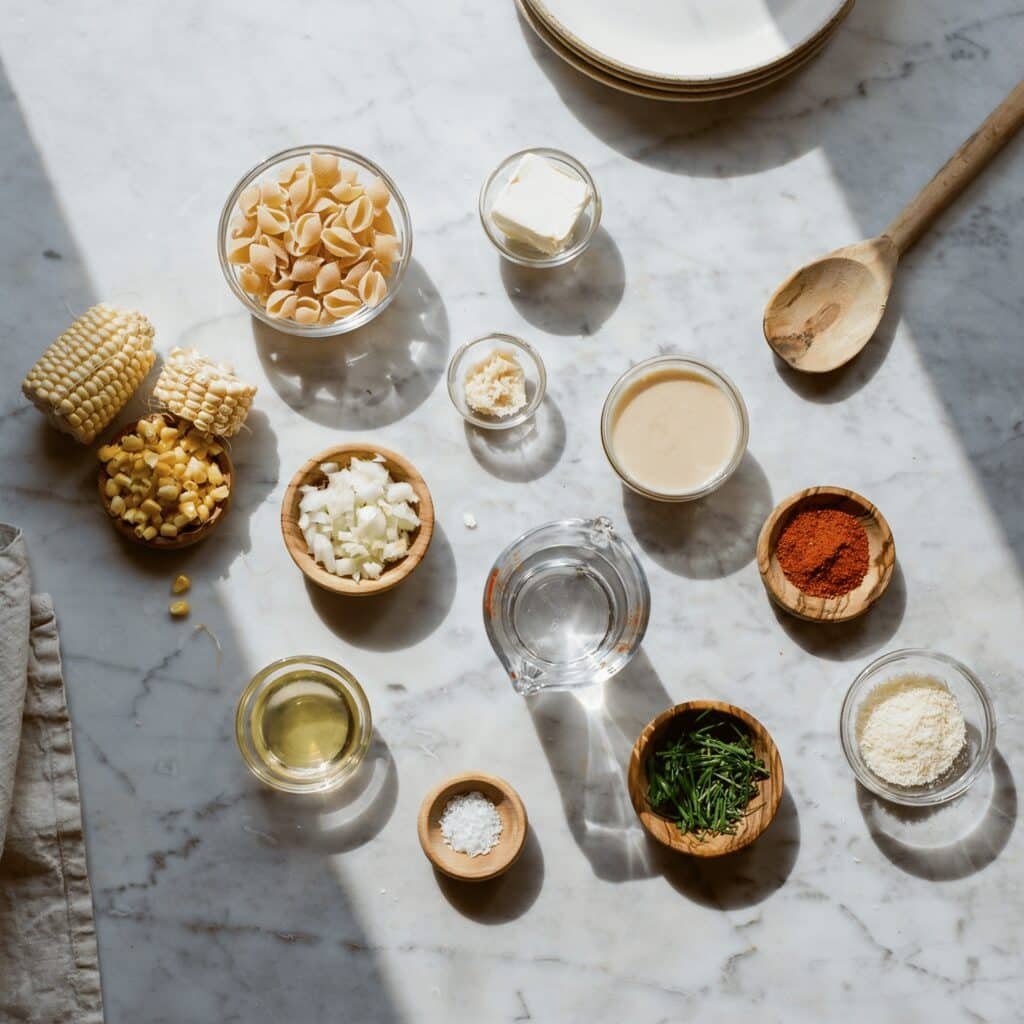
- 8 ounces campanelli pasta (about 3 cups)
- 2 ears fresh corn shucked (1 1/2 cups kernels)
- 3 tablespoons unsalted butter
- 1 yellow onion finely chopped (about 1 cup)
- 3/4 teaspoon grated garlic (from 2 small cloves)
- 1/2 cup water
- 2 tablespoons white miso
- 1/2 teaspoon gochugaru flakes
- 4 tablespoons chopped fresh chives divided
- 1 ounce Parmigiano-Reggiano cheese grated plus more to garnish (about 1/4 cup)
- 1 tablespoon fresh lemon juice
- kosher salt to taste.
- 1 Bring a medium pot of generously salted water to a boil. Cook the pasta to al dente, drain and reserve 1 cup of the cooking water. Set both aside separately.
- 2
Cut the kernels from the cobs into a medium bowl. Using the back of a knife or a spoon, scrape the stripped cobs over the bowl to extract the corn milk.- 3
Melt the butter in a large skillet over medium. Add the onion and cook until translucent, about 3 minutes. Add the garlic and cook 1 minute until fragrant. Add the corn with any corn milk and cook about 3 minutes, until it begins to soften and the mixture looks dry.- 4
Add the water and cook 3 to 4 minutes, stirring frequently, until most of it evaporates and the corn is tender. Remove from the heat and transfer 1/2 cup of the mixture to a small bowl. Transfer the rest to a food processor without wiping the skillet.- 5
Process the corn about 20 seconds until finely chopped and almost smooth. Add 1/4 cup of the reserved corn mixture and pulse twice more.- 6
Return the processed corn to the skillet over medium and warm through, about 1 minute. Whisk in the miso and 1/2 cup of the reserved pasta water.- 7
Add the gochugaru, drained pasta and 3 tablespoons of the chives and stir gently about 1 minute, until the pasta is coated.- 8
Remove from the heat and stir in the Parmigiano-Reggiano, then the remaining pasta water 1 tablespoon at a time until creamy. Stir in the lemon juice and season with salt.- 9
Divide among 4 bowls and top with the remaining chives, the reserved corn and extra Parmigiano-Reggiano. Serve immediately..NoteScrape the stripped cobs with the back of a knife to extract the corn milk, which carries flavour and starch. Cook the corn until the pan looks dry before adding water, then again until most of the water evaporates. Reserve half a cup of the cooked corn mixture before blending; a quarter cup is pulsed back in for texture and a quarter cup goes on top. Do not wipe the skillet between steps. Reserve a full cup of pasta water and add the second half a tablespoon at a time. Stir in the Parmesan off the heat so it does not split. Keeps 3 days refrigerated; loosen with water when reheating.
Silky, Sweet, Savory - 2