


A sweet spiced sourdough tied with string before baking so it emerges shaped like a pumpkin. Twelve servings across two days.
Cotton string, not twine
The notes are emphatic about this and add that they learned the hard way.
Food-grade cotton string is what you want. Kitchen twine sold for trussing is usually cotton too, but garden or craft twine can be jute, sisal or synthetic, none of which belong in a 450F oven against food.
Synthetic string melts. Jute and sisal are often treated with oils you would not want to eat.
Check the label says cotton and food safe.
The starter must be genuinely active

Which the notes stress, because there is no commercial yeast here at all.
Active means fed within the last four to twelve hours and visibly bubbly, ideally doubled. A starter straight from the fridge will not raise 475g of flour.
The float test is the usual check: a spoonful dropped in water should float. If it sinks, feed it and wait.
This is the single most common reason a sourdough loaf comes out dense.
Do not knead at the start
Combine only until it comes together, which the recipe specifies.
The thirty minute autolyse that follows does the work kneading would. Flour hydrates fully and gluten begins forming on its own, without any effort.
The stretch and folds afterwards develop it the rest of the way.
Four to six stretch and folds
In the first two hours, twenty to thirty minutes apart.
Each set is four movements: grab the edge, pull up, fold into the centre, turn the bowl a quarter and repeat.
This builds gluten in stages rather than all at once, which suits a wet dough that would be difficult to knead conventionally.
The dough visibly changes over the sets, going from shaggy to smooth and elastic.
Bulk ferment three to eight hours
Which is a wide range and it depends entirely on your kitchen.
Warm rooms ferment fast. A summer kitchen at 26C might be done in three hours; a cold one at 18C takes eight or more.
Judge by the dough rather than the clock: risen by roughly half, domed, with visible bubbles at the surface and edges.
Tie into eight even sections
Four strings arranged in a criss cross under the dough, each tied around it.
Four strings crossing gives eight segments, which is what reads as a pumpkin.
Tie snugly but not tight. The dough expands considerably in the oven and string tied hard cuts through it rather than shaping it.
Cold dough straight from the fridge is much easier to handle for this, which is why the overnight refrigeration comes first.
Ten grams of salt, weighed
Which is about a heaped teaspoon and a half, and weighing it matters more in bread than elsewhere.
Salt controls fermentation as well as flavour. Too little and the dough ferments fast and slack; too much and the starter is inhibited and the rise stalls.
Ten grams against 475g of flour is roughly two percent, which is the standard baker’s ratio. The recipe is written in grams throughout for exactly this reason.
Preheat to 500F, bake at 450F
The dutch oven goes in at 500F and the temperature drops once the bread is in.
That initial blast is what creates oven spring, the rapid rise in the first few minutes before the crust sets. A cold pot loses that entirely.
Twenty minutes with the lid on traps steam for the spring, then twenty with it off to brown and crisp the crust.
Cool completely before serving
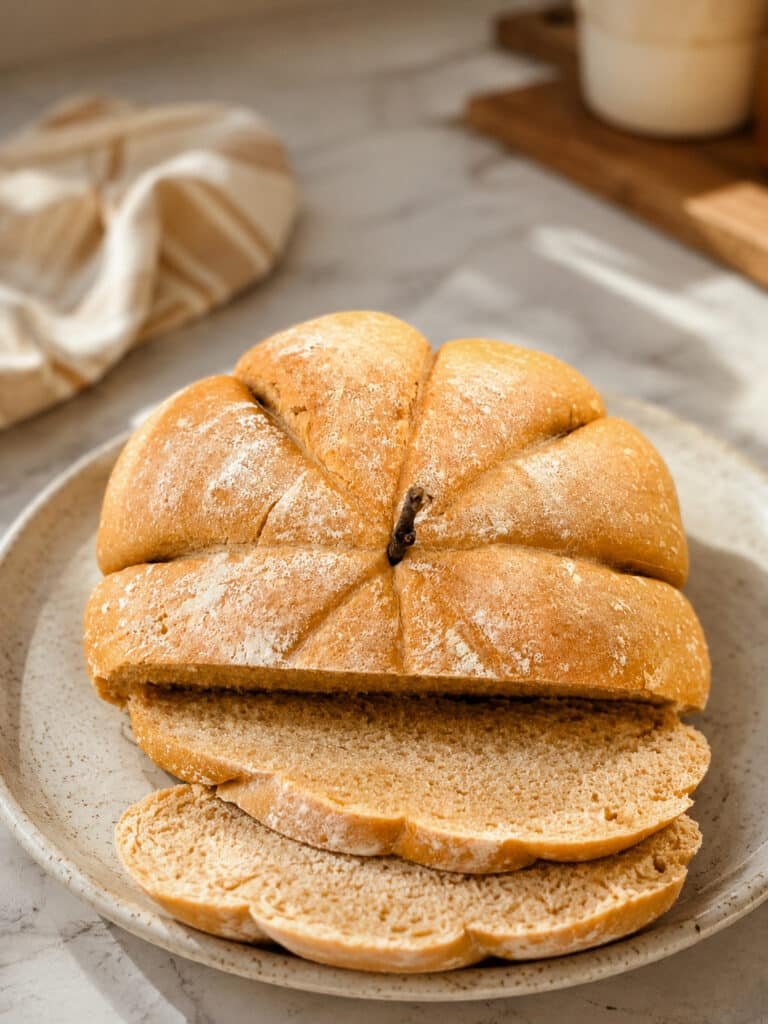
Which is standard for sourdough and often ignored.
Bread continues cooking as it cools, and cutting warm sourdough gives you a gummy, compressed crumb. A couple of hours at minimum.
Adding a stem
The notes suggest a small cinnamon stick or a clean stick from the garden pushed into the top after baking. It is what completes the look.
Scoring the sections
Scoring along each string line before baking deepens the segments and makes the pumpkin shape more pronounced.
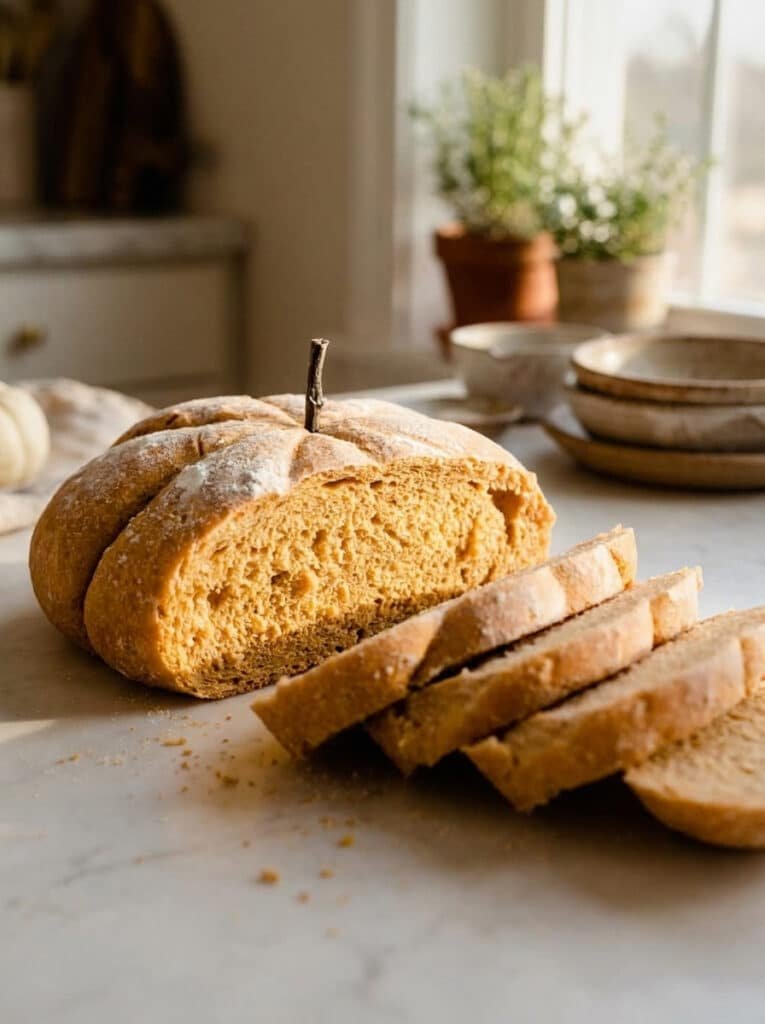

Pumpkin Shaped Sourdough Bread
Description
A naturally leavened pumpkin bread shaped with string, baked in a dutch oven.
Ingredients:
Instructions
-
Place a bowl on a kitchen scale and tare it. Add the flour, active starter, water, pumpkin puree, salt, sugar and pumpkin spice and combine until it just comes together. Do not knead.
-
Cover and allow to autolyse for 30 minutes.
-
Perform 4 to 6 stretch and folds in the first two hours, about 20 to 30 minutes apart. Grab the edge of the dough firmly, pull up and fold into the centre, turn the bowl a quarter and repeat three more times.
-
Cover with a tight lid or plastic wrap and bulk ferment 3 to 8 hours, judging by the dough: risen by roughly half, domed, with visible bubbles.
-
Shape into a ball and place in a banneton. Put it in a plastic bag and refrigerate overnight.
-
The next day preheat a cast iron dutch oven to 500F. Cut 4 lengths of food-grade cotton string about 20 inches each and arrange them in a criss cross pattern on parchment paper.
-
Place the cold dough top side down on the strings. Tie each string around the dough so you have 8 even sections, snug but not tight, as the dough expands in the oven.
-
Reduce the oven to 450F and bake 20 minutes with the lid on, then 20 minutes with the lid off. Cool completely before serving..
Note
Use food-grade cotton string rather than twine, which the notes stress from experience: garden or craft twine may be jute, sisal or synthetic, none of which belong in a 450F oven against food. The starter must be genuinely active and bubbly, fed within the last 4 to 12 hours, since there is no commercial yeast here; use the float test. Do not knead at the start, as the 30 minute autolyse and the stretch and folds do that work. Bulk ferment 3 to 8 hours judged by the dough rather than the clock: risen by half, domed, with visible bubbles. Tie the four strings snugly but not tight, since the dough expands and tight string cuts through. Cold dough from the fridge is much easier to tie. Preheat the dutch oven to 500F then reduce to 450F, as the initial blast creates oven spring. Cool completely before cutting.