


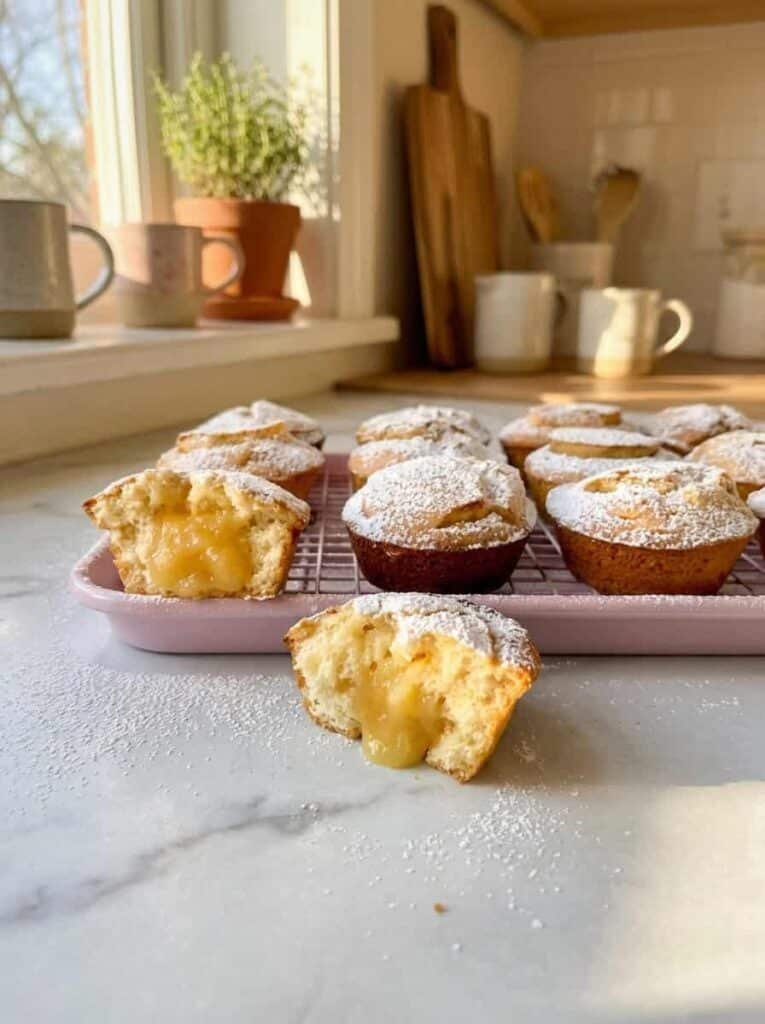

Pancake mix as the base of a cupcake, with a spoonful of lemon curd hidden in the middle of each one.
Twelve cakes, thirty five minutes, and no electric mixer anywhere.
Batter under the curd, batter over the curd
A heaped tablespoon of batter into each hole first, then the curd, then the remaining batter over the top to encase it.
The order matters and so do the proportions. Curd sinks as it heats while the batter rises around it, so you need more batter underneath than above. Put the curd in first and it sinks straight to the bottom and welds to the pan.
The layer on top only needs to be thin. Its job is to close the surface so the curd does not break through and leave a hole in the finished cake.
Neatness does not matter here. Nobody sees the inside until they bite it.
Pancake mix instead of flour
350g, which is most of a standard box.

Pancake mix already contains flour, raising agents, a little salt and some sugar, so it works as a shortcut cake flour. That is why there is no baking powder in the ingredient list and nothing to measure in quarter teaspoons.
It also produces a distinctly light, soft crumb, closer to a pancake than to a dense cupcake, which is the appeal.
Any plain pancake mix works. Ones with added flavourings or buttermilk powder will taste of that, which may or may not suit lemon.
Milk instead of water
125ml of full cream milk, replacing the water the box directions would call for.
Water hydrates the mix and does nothing else. Milk brings fat, protein and sugar, which give a richer flavour and a softer crumb.
This is a small change with a disproportionate effect, and it is worth doing in any recipe that repurposes a pancake or muffin mix.
Oil rather than butter
80ml of rice bran oil, or any neutral oil.
Oil is liquid at room temperature, so these stay soft as they cool where a butter cake firms up. It also means no melting step, which is part of why this is a recipe you can make with children.
Neutral is the requirement. Olive oil would compete with the lemon.
Whisk until smooth, in one bowl
Everything into a large bowl together and whisked.
Unlike most cake batters there is no warning here about overmixing, because pancake mix is formulated to tolerate it. You are not developing a delicate structure, you are hydrating a pre-balanced mix.
Smooth is the target. Lumps of dry mix will show up as pale patches.
Fifteen minutes at 180C
Or 160C fan forced, until golden and puffed.
That is a short bake and it suits small cakes with a wet centre. Longer and the curd, which is essentially a custard, can split and go grainy.
Golden and puffed is the visual cue. A skewer test is not useful here since you would hit curd.
Five minutes in the pan, then out
Then onto a wire rack to cool completely.
The five minutes lets them firm enough to turn out without tearing. Longer in the pan and steam condenses underneath, making the bottoms damp.
Cooling completely matters more than usual because of the curd. Warm, it is liquid and runs out the moment you bite. Cool, it stays as a distinct glossy centre.
Store bought curd is fine
150g, which is half a jar.
The recipe is built around convenience and shop-bought curd is part of that. Quality varies considerably though: better jars list egg and butter high in the ingredients, cheaper ones lean on cornflour and colouring.
Homemade curd works if you have some, and it will be looser, so use slightly less per cake.
Serving and keeping
Dusted with icing sugar, which is optional and makes them look finished.
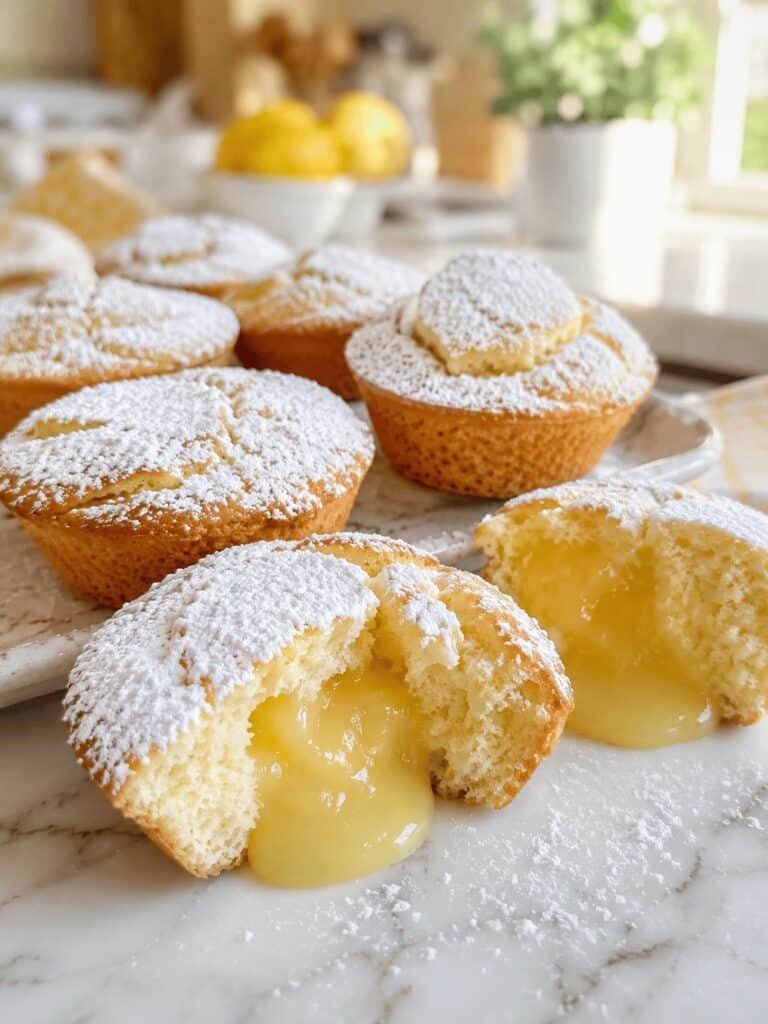
Best on the day. They keep two days in an airtight container, though the curd gradually soaks into the surrounding crumb and the surprise centre becomes less distinct.
Making them with children
This is a genuinely good recipe for it. There is no hot butter, no electric mixer, and nothing sharp. Children can whisk the batter, spoon it into the holes and add the curd.
The only adult jobs are the oven and turning the hot pan out.
Other fillings
Any thick fruit curd or jam works the same way. Raspberry jam, passionfruit curd and lemon are all good. Thin jams run and will not stay as a centre; look for something that holds its shape on a spoon.
Pancake Mix Lemon Curd Cakes
Description
Soft twelve-hole cupcakes made with pancake mix, milk and oil, each with an oozy lemon curd centre.
Ingredients:
Instructions
-
Preheat the oven to 180C, or 160C fan forced. Grease a 12-hole muffin pan.
-
Place the pancake mix, caster sugar, milk, egg and oil in a large bowl and whisk until smooth.
-
Spoon about 1 heaped tablespoon of the mixture into each muffin hole. Divide the lemon curd among the holes, then evenly top each with the remaining batter to encase the curd. Keep more batter underneath the curd than above it.
-
Bake 15 minutes, until the cakes are golden and puffed.
-
Cool in the pan 5 minutes before turning out onto a wire rack to cool completely. Serve dusted with icing sugar if using..
Note
Put more batter underneath the curd than above it, since the curd sinks while the batter rises. The top layer only needs to be thin, to stop the curd breaking through. Use milk rather than the water the pancake box would call for, which gives a richer flavour and softer crumb. Use a neutral oil. Bake only 15 minutes; longer and the curd can split. Cool completely before eating, as warm curd runs straight out. Store-bought curd is what the recipe assumes; homemade is looser so use slightly less. Keeps 2 days airtight, though the curd soaks into the crumb over time.